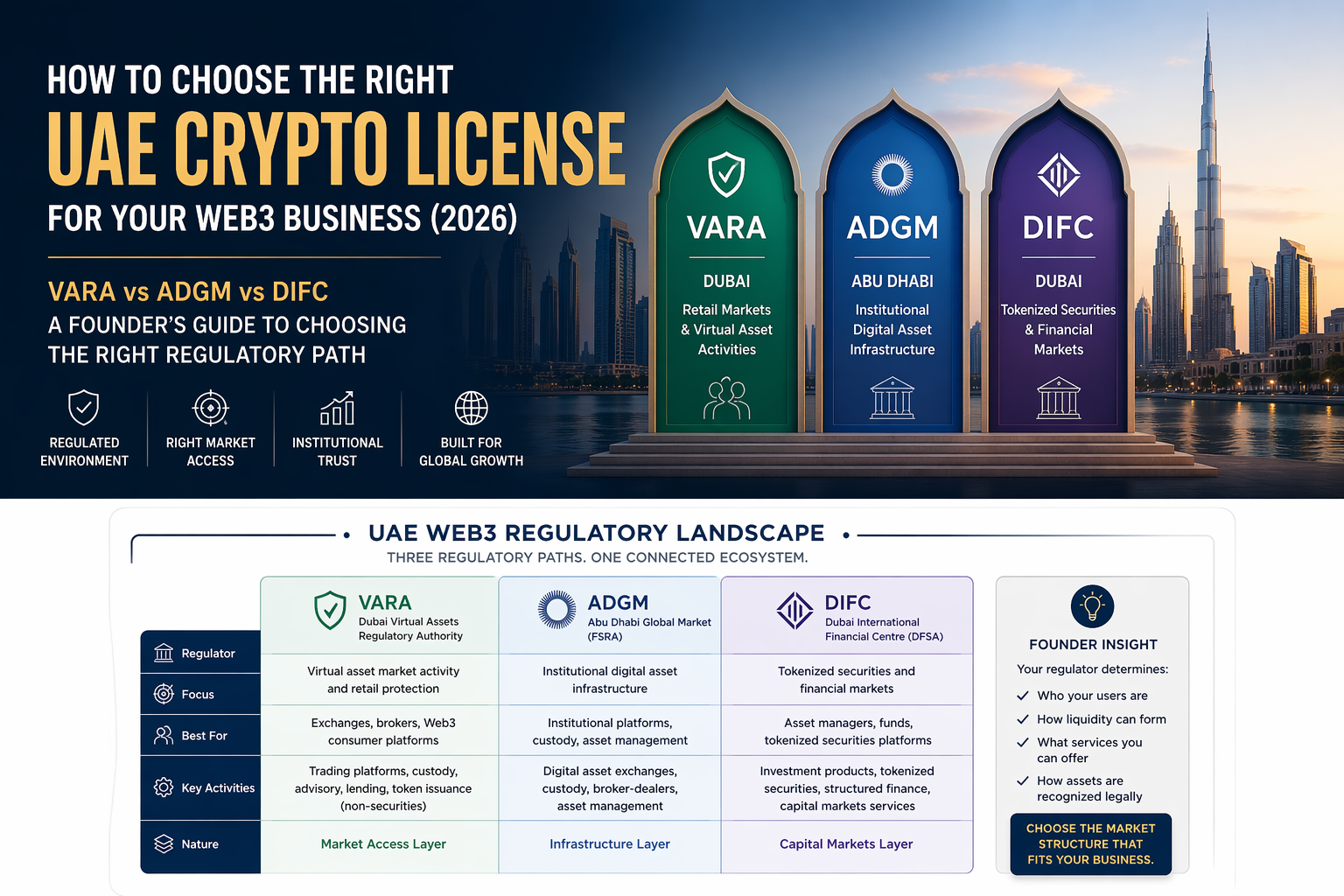
UAE Crypto License – UAE crypto license guide 2026: compare VARA, ADGM, DIFC, CMA and CBUAE rules, licensing requirements, costs and application steps.
Choosing the right regulatory framework for crypto exchanges, custody providers, tokenization platforms, Web3 businesses and digital payment services.
A crypto exchange and a tokenization platform may both want to establish a business in Dubai. They may even use similar blockchain technology.
But that does not mean they need the same licence.
The exchange may handle customer orders, trading and settlement. The tokenization platform may issue digital representations of securities, property interests or other assets.
A payment company may convert payment tokens or facilitate transfers between customers and merchants.
Each business creates different regulatory and operational responsibilities.
This is why choosing a UAE crypto licence should begin with the business model, not the jurisdiction.
In 2026, founders must navigate a regulatory landscape involving Dubai’s Virtual Assets Regulatory Authority (VARA), Abu Dhabi Global Market (ADGM), Dubai International Financial Centre (DIFC), the federal Capital Market Authority (CMA) and the Central Bank of the UAE (CBUAE).
The practical question is not which regulator has the most attractive reputation.
It is which regulatory framework covers the activities a company actually intends to undertake.
1. Understanding the UAE crypto regulatory landscape in 2026
The UAE does not operate under one universal crypto licence.
Regulatory responsibilities depend on the location of the business, the type of digital asset, the services provided and the relevant legal framework.
Five authorities are particularly important.
| Authority | Regulatory responsibility |
|---|---|
| VARA | Specified virtual-asset activities in Dubai, excluding DIFC |
| ADGM / FSRA | Regulated financial services and digital-asset activities within ADGM |
| DIFC / DFSA | Financial services involving crypto tokens and other regulated financial products within DIFC |
| Federal CMA | Capital-market activities and virtual-asset services within its federal jurisdiction |
| CBUAE | Banking, payment services and payment-token activities within its regulatory scope |
These frameworks may interact.
For example, a business operating a virtual-asset exchange may need to consider payment-token requirements if it also introduces regulated payment services.
Similarly, a company issuing tokenized investment products needs to establish whether the underlying instrument is a security or another regulated financial product.
The technology alone does not determine the regulatory treatment.
2. VARA: Crypto licensing in Dubai
The Virtual Assets Regulatory Authority (VARA) regulates specified virtual-asset activities in and from Dubai, including its free zones, but excluding DIFC.
VARA’s framework covers eight regulated activities:
- Virtual-asset advisory services
- Broker-dealer services
- Custody services
- Exchange services
- Lending and borrowing services
- Management and investment services
- Transfer and settlement services
- Category 1 virtual-asset issuance
A company may seek permission for more than one activity, subject to the applicable requirements.
However, VARA requires virtual-asset custody services to be conducted through a distinct legal entity with a standalone licence.
An exchange, for example, cannot assume that its exchange authorization automatically permits it to operate a separate regulated custody business.
How to apply for a VARA licence
For new firms, VARA describes a two-stage licensing process.
Stage 1: Approval to Incorporate
The applicant submits an Initial Disclosure Questionnaire through Dubai Economy and Tourism or the relevant Dubai free-zone authority.
The application process includes an assessment of the proposed activities, business plan, ownership and senior management.
If the application progresses successfully, VARA may issue an Approval to Incorporate, allowing the applicant to complete its legal incorporation and operational preparations.
This is not permission to begin conducting regulated virtual-asset activities.
Stage 2: VASP licence
The applicant proceeds with the full licensing requirements.
VARA may review governance arrangements, regulatory documentation, operational systems, financial resources, compliance procedures and technical controls.
Further submissions, meetings or clarifications may be required.
A firm can begin the approved virtual-asset activities only after receiving the necessary licence and satisfying its applicable conditions.
Founders should distinguish between an initial application, Approval to Incorporate, In-Principle Approval and a full operational licence.
Official reference: VARA Licence Applications
3. ADGM: Financial services and digital assets in Abu Dhabi
Abu Dhabi Global Market is an international financial centre with its own legal and regulatory framework.
Its Financial Services Regulatory Authority (FSRA) regulates authorized financial services within ADGM, including activities involving virtual assets and digital securities.
Its framework covers activities such as dealing, custody and operating multilateral trading facilities, subject to the relevant permissions and conditions.
ADGM has also developed specific guidance addressing virtual-asset activities and the regulation of digital securities.
For founders considering ADGM, the distinction between a virtual asset and a digital security is important.
A company operating a virtual-asset trading facility has different requirements from a business arranging investments in tokenized securities.
The FSRA’s assessment considers the proposed services, financial resources, governance, operational arrangements, technology and risks.
Is ADGM only for institutional businesses?
No.
ADGM is frequently associated with institutional financial services, but it is not exclusively an institutional market.
The customer categories a firm can serve depend on its specific Financial Services Permission and the conditions attached to it.
A founder should therefore examine the relevant authorization rather than assume that every ADGM-regulated business is restricted to professional or institutional customers.
ADGM also requires firms to consider whether the virtual assets they intend to support are acceptable under its regulatory framework.
Official reference: ADGM
4. DIFC: The DFSA framework for digital assets
Dubai International Financial Centre operates under its own legal and regulatory framework.
The Dubai Financial Services Authority (DFSA) supervises regulated financial services conducted in or from DIFC.
DIFC’s framework is relevant to businesses providing financial services involving crypto tokens, investment products, securities and other regulated financial instruments.
The legal classification of the asset and the financial service being performed determine the applicable requirements.
What changed in 2026?
The DFSA introduced updates to its Crypto Token framework that took effect on 12 January 2026.
One important change concerns responsibility for token suitability.
Instead of relying on a prescribed list of recognized crypto tokens maintained by the DFSA, firms must assess and document whether the crypto tokens they intend to use satisfy the applicable suitability criteria.
The revised framework also strengthens requirements relating to governance, custody, disclosures and investor safeguards.
For a business entering DIFC, token selection is therefore part of its regulatory and risk-management responsibilities.
Founders developing tokenized financial products should also distinguish between a token representing a regulated investment and a crypto token covered by the separate Crypto Token framework.
Official reference: DFSA Crypto Token Regulation
5. The federal Capital Market Authority: An important 2026 development
The UAE’s federal capital-market framework underwent a significant change in 2026.
The former Securities and Commodities Authority was succeeded by the Capital Market Authority (CMA) under the new federal capital-market legislation.
In April 2026, the CMA announced a virtual-assets framework consisting of five principal regulatory modules and eight regulated activities.
The activities include dealing in virtual assets, custody, arranging custody, investment advice, portfolio management and operating multilateral trading facilities.
The framework also addresses trading facilities for tokenized securities.
This is particularly relevant to businesses considering activities outside the financial free zones and other jurisdictions with their own applicable regulatory arrangements.
However, federal regulation does not mean that VARA, the FSRA and the DFSA have ceased to exercise their respective responsibilities.
Businesses need to understand how the applicable federal, local and financial-free-zone rules interact.
Founders should obtain an activity-specific assessment before assuming that an authorization in one jurisdiction covers operations in another.
Official reference: UAE Capital Market Authority
6. CBUAE: Stablecoins and payment-token services
The Central Bank is another important part of the UAE’s digital-asset regulatory architecture.
Its Payment Token Services Regulation took effect on 31 August 2024.
The regulation covers three principal categories of payment-token services:
- Payment-token issuance
- Payment-token conversion
- Payment-token custody and transfer
It provides for licensing or registration arrangements according to the activity, type of payment token, and status of the service provider.
The regulation must also be read with its jurisdictional scope, restrictions and exclusions.
For example, an exchange that introduces payment-token conversion cannot assume that its virtual-asset authorization automatically covers every payment service it wishes to offer.
Similarly, a company issuing an AED-referenced payment token needs to consider the applicable Central Bank requirements.
The analysis can be more complicated for businesses combining merchant payment gateways, crypto conversion, settlement and wallet services.
The operational responsibilities of each participant must be clearly established.
This is also important for white-label technology providers. Supplying software is not necessarily the same activity as issuing, converting, or transferring payment tokens.
But providing or enabling financial services through technology can bring additional regulatory questions.
Official reference: CBUAE Payment Token Services Regulation
7. How to choose the right UAE crypto licence for your business
The starting point is to map what happens when a customer uses the product.
Consider four common business models.
A. Crypto exchange
A crypto exchange needs to identify who operates the trading venue, handles customer orders, provides liquidity, holds customer assets, and completes settlement.
Its proposed location and services will determine whether it should assess VARA, the FSRA, the DFSA, or another applicable regulatory framework.
If the exchange also provides custody, brokerage or payment services, additional permissions or regulatory requirements may apply.
B. Custody provider
A custody provider must establish who holds the private keys, controls customer assets and authorizes transactions.
Customer-asset segregation, governance, cybersecurity, insurance where required, business continuity and insolvency arrangements are important parts of the operating model.
The distinction between developing wallet software and safeguarding assets on behalf of customers also matters.
C. Tokenization platform
For tokenization, the first question is what legal rights the token represents.
A token may represent a security, contractual entitlement, beneficial interest or another form of claim.
Creating a token does not automatically transfer legal ownership of the underlying asset.
The regulatory assessment should address the underlying instrument, issuer, investor rights, offering arrangements, custody and secondary-market activity.
A platform offering tokenized securities may face different requirements from one providing only technical infrastructure.
D. Payment and fintech company
A payment company should define how funds and tokens move through its system.
Does it issue payment tokens, convert them, hold them for customers or arrange transfers?
Which entity receives fiat currency? Which entity handles settlement? Where are customer funds held?
These operational details help determine the applicable Central Bank requirements and whether other virtual-asset permissions are also relevant.
8. How much does a UAE crypto licence cost in 2026?
There is no single licensing fee that applies to every UAE crypto business.
The financial requirements depend on the regulator, licensed activities, operational model and applicable prudential rules.
A realistic budget needs to account for more than the initial application.
| Cost component | What founders should consider |
|---|---|
| Application and licensing | Regulatory application fees and relevant permissions |
| Annual supervision | Recurring fees applicable to the licensed activities |
| Capital requirements | Required paid-up or regulatory capital |
| Company establishment | Incorporation, premises and related expenses |
| Compliance | AML, sanctions, KYC, transaction monitoring and reporting |
| Technology | Cybersecurity, infrastructure, testing and relevant audits |
| Staffing | Qualified management, compliance and technical personnel |
| Operations | Custody, banking, settlement, insurance where required and ongoing support |
For VARA applicants, the applicable fee provisions are set out in its regulations, while capital requirements are addressed in its Company Rulebook.
Other regulatory frameworks have their own fee schedules and financial-resource requirements.
A business seeking multiple permissions may face materially different costs from a company offering one narrowly defined service.
Founders should therefore prepare an activity-specific budget and confirm the current requirements directly with the relevant authority.
An inexpensive company-formation package is not a substitute for the regulatory authorization needed to conduct financial or virtual-asset activities.
9. Documents and preparation for a crypto licence application
Although documentation varies by jurisdiction and activity, founders should expect a detailed assessment of their proposed business.
Important preparation areas include the regulatory business plan, ownership structure, management, financial resources, compliance and technology.
VARA’s published application guidance, for example, identifies documents such as:
- Corporate and beneficial-ownership information
- Regulatory business plan and financial projections
- Governance and organizational structure
- Details of key personnel
- Source-of-funds and capital evidence
- Risk-management and compliance arrangements
- Technology and security information
- Insurance documentation, where applicable
- Business continuity and wind-down planning
Other authorities have their own application requirements.
The purpose of the preparation is not simply to assemble paperwork.
The business must be able to demonstrate how it will operate, manage risk, protect customers and satisfy its continuing regulatory obligations.
10. What founders frequently overlook
Choosing a jurisdiction is only one part of establishing a digital-asset business.
Several commercial questions deserve equal attention.
Banking and fiat access
A regulatory licence does not automatically provide a banking relationship. Banking due diligence and the proposed movement of customer funds need to be considered separately.
Custody and settlement
Trading functionality is not enough. The business needs a workable arrangement for safeguarding assets, completing transactions, and managing operational failures.
Liquidity
A licensed exchange still needs customers, liquidity providers and a functioning market structure. Regulatory approval does not create trading demand.
Distribution
The company needs a credible way to reach its intended customers while complying with applicable marketing and solicitation requirements.
Cross-border operations
A UAE authorization does not automatically permit a business to provide regulated services in every foreign market.
The cost of operating after approval
Staffing, security, reporting, audits, compliance and banking arrangements create recurring obligations.
For founders, these questions should be addressed alongside licensing, rather than left until immediately before launch.
11. A practical UAE market-entry checklist
Before applying for a licence, a founder should be able to answer the following questions:
- What product or service are we providing?
- What is the legal classification of the digital assets involved?
- Are our customers retail users, professional clients, institutions, or other businesses?
- Where will those customers be located?
- Which entity handles customer orders, assets, and settlement?
- Do we provide regulated financial services, technology infrastructure, or both?
- Which regulatory permissions are required for the proposed activities?
- What banking, custody, payment and liquidity relationships will the business need?
- Can we demonstrate adequate financial resources and operational readiness?
- How will the business acquire customers and generate sustainable revenue?
Once these questions are answered, the choice of regulatory framework becomes considerably clearer.
FAQs
What is the best crypto licence in the UAE?
How do I obtain a crypto exchange licence in Dubai?
There is no universal licence suitable for every crypto business. The appropriate authorization depends on the regulated activities, asset classification, operating location, and customer base
A company seeking to operate a regulated virtual-asset exchange in Dubai outside DIFC should assess VARA’s Exchange Services requirements and applicable licensing process. Its application will also need to address any additional activities it intends to provide.
Is VARA only for retail crypto exchanges?
No. VARA regulates specified virtual-asset activities in Dubai outside DIFC and can authorize businesses serving different customer categories, subject to their approved permissions and conditions.
Can I obtain an ADGM crypto licence?
Firms seeking to undertake regulated financial services in ADGM must assess the relevant FSRA authorization requirements and obtain the necessary Financial Services Permission before conducting regulated activities.
Is tokenization regulated in the UAE?
Tokenization may involve regulated activities, depending on the underlying asset, legal rights, issuance arrangements, and services provided. Tokenized securities, payment tokens, and other virtual assets may fall under different frameworks.
Does a UAE crypto licence allow global operations?
No. A UAE authorization does not automatically permit regulated activities in foreign jurisdictions. Cross-border operations must be assessed under the laws of the countries involved.
Does a white-label crypto platform need a licence?
That depends on its actual activities and responsibilities. A business supplying software without conducting regulated activities may have different obligations from one that also operates an exchange, controls customer assets, or provides payment services.
Conclusion
Choose the operating model before the regulator.
The UAE provides several regulatory routes for digital-asset businesses. The challenge is identifying which route applies to a particular commercial and operational model.
A company may have a technically sophisticated product and a well-prepared application yet still face difficulties if its banking arrangements, custody model, customer acquisition or settlement infrastructure are unresolved.
Regulatory planning and commercial planning should therefore proceed together.
The licence establishes what the business is authorized to do.
The operating model determines whether it can deliver that service to customers.
For founders entering the UAE, understanding both is essential.
Official regulatory references
- VARA – Licence Applications
- VARA – Licensed Activities
- ADGM – Official Regulatory and Legal Framework
- DFSA – Crypto Token Regulation
- UAE Capital Market Authority
- CBUAE – Payment Token Services Regulation
Related research
- UAE Web3 Regulatory Architecture – Founder Guide
- VARA Rulebook Dubai 2026
- VARA vs DIFC: Tokenization Regulation
- Tokenized Exposure vs Tokenized Ownership
- VARA MVP License Dubai
Research updated: 1 October 2026.
Disclaimer: This article provides independent research and general information. It is not legal, financial, investment or regulatory advice. Businesses should obtain qualified advice based on their specific activities and confirm current requirements with the relevant authority.