UAE Stablecoins Guide (2026)The Stablecoins landscape is evolving faster than most markets can interpret.
While many jurisdictions are still debating how to regulate Stablecoins, or whether central bank digital currencies (CBDCs) should exist at all, the UAE has adopted a more structured approach. –
Rather than treating digital money as a single product category, the UAE is developing multiple layers of regulated payment infrastructure that serve different roles within the financial system.
From the Digital Dirham strategy launched in 2023 to the emergence of dirham-backed stablecoins such as DDSC, a clear pattern is beginning to emerge.
These initiatives are not isolated developments. Together, they reflect a broader financial architecture that combines central bank oversight, regulated payment tokens, and blockchain-based settlement.
This guide examines how these developments connect, the roles of the Digital Dirham and DDSC, and what they could mean for the future of digital payments and tokenized finance in the UAE.
Key Takeaways-UAE Stablecoins Guide (2026)
- The UAE is developing a layered digital money ecosystem rather than relying on a single digital currency.
- The Digital Dirham (CBDC) and DDSC serve different but complementary roles.
- The CBUAE provides the regulatory and monetary foundation for this ecosystem.
- The focus is shifting from crypto trading to regulated payment infrastructure.
- The UAE’s approach could influence future cross-border digital payment networks.
Table of Contents
UAE Stablecoins Guide (2026) – How the UAE Built Its Stablecoins Infrastructure
The UAE’s stablecoin ecosystem did not emerge overnight. It is the result of a deliberate regulatory and infrastructure strategy developed over several years.
In March 2023, the Central Bank of the UAE (CBUAE) launched its Digital Dirham Strategy, marking an important step in the country’s digital transformation agenda.
Rather than introducing a single form of digital money, the strategy established a two-track framework:
- Wholesale CBDC for interbank settlement and financial institutions.
- Retail and cross-border payment infrastructure for consumers and businesses.
This distinction is significant because it recognises that modern payment systems operate across multiple layers, each serving different participants and use cases.
Building on this foundation, the CBUAE introduced a regulatory framework for payment token services in 2024, establishing requirements for:
- Eligible stablecoin issuers
- Reserve backing and safeguarding of customer funds
- Licensing and regulatory oversight
While many jurisdictions were still debating how Stablecoins should be regulated, the UAE was developing the legal and operational framework needed to support their adoption.
It is within this regulatory foundation that DDSC later emerged as one of the UAE’s regulated dirham-backed Stablecoins.
UAE Stablecoins Guide (2026)
What Is DDSC? Understanding the UAE’s Regulated Stablecoins Model
DDSC is a UAE dirham-backed stablecoin designed to operate within the country’s regulated digital payments framework.
Unlike many stablecoins that originate as private technology initiatives, DDSC has been developed through collaboration between regulated financial institutions and blockchain infrastructure providers.
Its core characteristics include:
- 1:1 backing with UAE dirham reserves
- A framework developed under the Central Bank of the UAE’s regulatory oversight
- Blockchain infrastructure designed to support secure and regulated digital payments
The project also demonstrates how different organisations contribute specialised roles within a regulated ecosystem:
| Organisation | Role |
|---|---|
| International Holding Company (IHC) | Strategic project initiation |
| First Abu Dhabi Bank (FAB) | Banking and custody infrastructure |
| ADI Foundation | Blockchain infrastructure |
| Sirius International | Deployment and ecosystem adoption |
Rather than relying on a single organisation, DDSC brings together banking, regulatory oversight, blockchain technology and commercial deployment.
This multi-participant structure illustrates how the UAE is building digital payment infrastructure through collaboration between financial institutions, technology providers and licensed market participants.
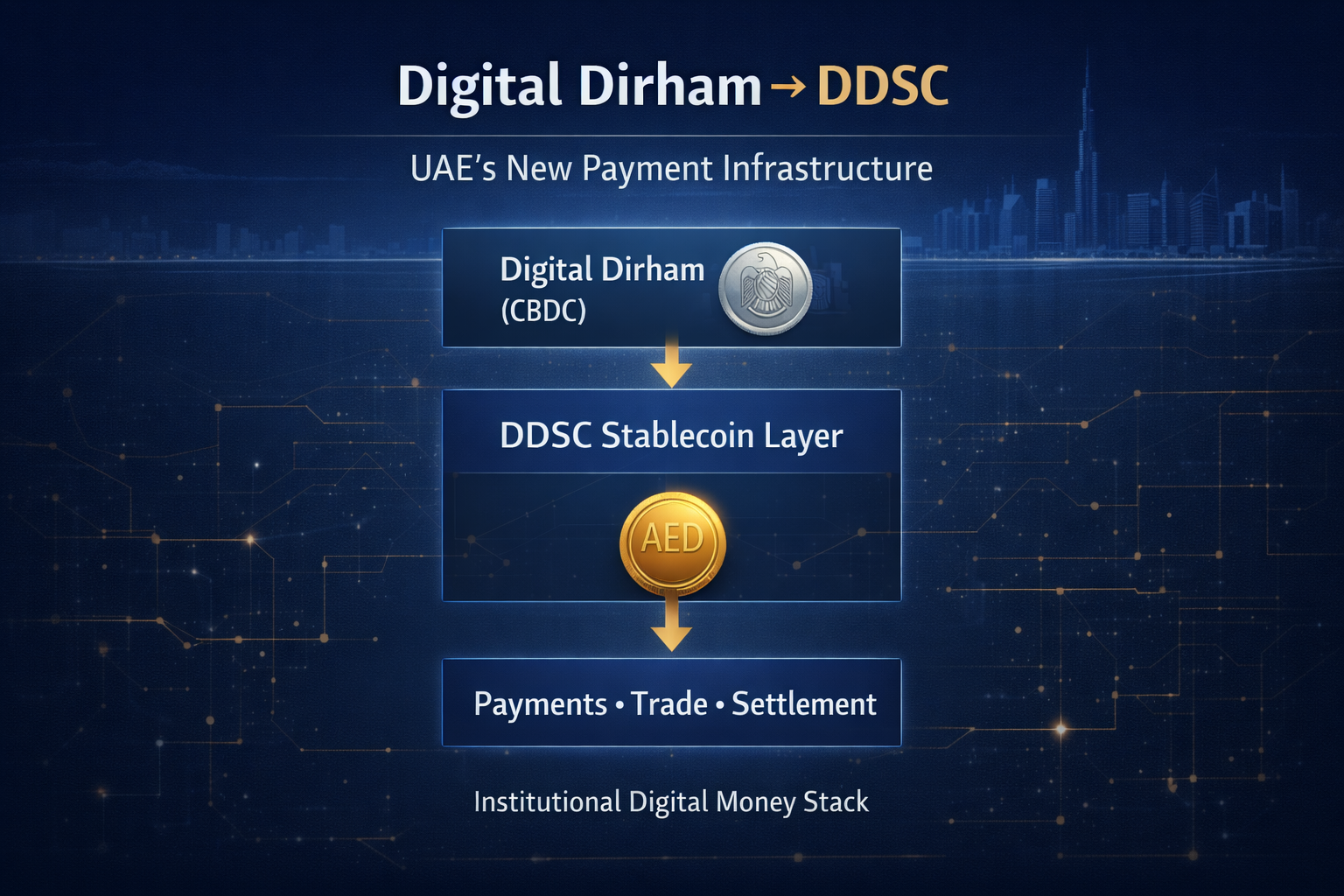
The relationship between these layers can be visualised as follows:
Layered structure of the UAE’s digital money infrastructure, illustrating how the Digital Dirham (CBDC), regulated Stablecoins such as DDSC, banking and custody services, and real-world payment applications operate as complementary layers within the financial ecosystem.

UAE Stablecoins Guide (2026)- How DDSC Differs from Global Stablecoins Models
The global stablecoin market has largely been shaped by US dollar-backed stablecoins that facilitate trading, liquidity and settlement within cryptocurrency markets.
The UAE’s approach reflects a different objective.
Rather than focusing primarily on crypto trading, DDSC has been designed to support regulated financial activities within the broader economy.
Its intended use cases include:
- Institutional payments
- Treasury and liquidity management
- Trade and supply chain settlement
- Programmable financial services
- Tokenized asset settlement
This represents a broader shift from using stablecoins as crypto trading instruments toward integrating them into regulated financial infrastructure.
As the UAE expands its digital payments ecosystem, Stablecoins such as DDSC are positioned to complement traditional banking systems.
Rather than replace them, enabling more efficient settlement while operating within an established regulatory framework.

UAE Stablecoins Guide (2026)-Beyond a Single UAE Stablecoins
DDSC should not be viewed as an isolated initiative. Instead, it can be understood as part of the UAE’s broader strategy to modernise digital payments and financial market infrastructure.
As the ecosystem develops, policymakers and market participants are exploring opportunities for:
- Greater interoperability across payment networks
- Cross-border settlement using regulated digital assets
- Integration with regional financial infrastructure
- Support for trade and programmable financial services
Given the UAE’s role as a global trade and financial hub, these developments could strengthen payment connectivity across the GCC, the Middle East and North Africa (MENA), Africa, and Asia.
Rather than focusing on a single stablecoin, the long-term direction points towards an ecosystem where regulated digital currencies, payment tokens and financial institutions can interact through interoperable infrastructure.
For a country with significant cross-border payment flows, this represents a strategic step towards faster, more efficient and programmable settlement systems.
UAE Stablecoins Guide (2026) – What This Means for Blockchain Payments
The UAE’s stablecoin strategy illustrates a broader shift in how blockchain technology is being integrated into modern financial systems.
Rather than focusing solely on token issuance or cryptocurrency trading, the emphasis is increasingly moving towards:
- Settlement infrastructure
- Regulatory clarity
- Institutional participation
- Real-world payment applications
This reflects an important evolution in the role of blockchain.
Instead of being viewed primarily as a technology for digital assets, blockchain is increasingly being deployed as part of regulated financial infrastructure.
Which supports payments, settlement and tokenized markets.
The UAE’s approach suggests that the future of blockchain may be defined less by speculation.
And more by its ability to improve the efficiency, transparency and interoperability of financial systems.
Conclusion – UAE Stablecoins Guide (2026)
The UAE’s stablecoin ecosystem reflects a shift from experimentation to implementation.
With the Digital Dirham providing the central bank foundation and DDSC demonstrating a regulated dirham-backed stablecoin model, a layered digital payments ecosystem is beginning to emerge.
The key question is no longer whether stablecoins will play a role in modern finance. Instead, it is how they will integrate with commercial banks, central bank infrastructure, tokenized assets and cross-border payment networks.
The UAE is positioning itself as one of the first jurisdictions to demonstrate how regulated stablecoins, central bank digital currencies and blockchain-based financial infrastructure can operate together within a coherent regulatory framework.
As this ecosystem continues to evolve, the lessons emerging from the UAE may influence how other financial centres approach digital money, payments and tokenized markets.
Related Research
UAE Crypto License Guide (2026)
Tokenized Exposure vs Tokenized Ownership
Custody, Settlement & Ownership
Read here https://www.centralbank.ae/en/
FAQs
What is DDSC, and how is it different from other stablecoins?
DDSC is a UAE dirham-backed stablecoin approved by the Central Bank of the UAE. Unlike most global stablecoins that primarily support crypto trading, DDSC is designed for institutional use cases such as payments, treasury operations, and trade settlement within a regulated financial system.
How does DDSC relate to the Digital Dirham initiative?
DDSC is part of the broader Digital dirham strategy launched by the Central Bank in 2023. While the Digital Dirham focuses on central bank digital currency(CBDC) use cases, DDSC represents a regulated private-sector stablecoin operating within that same monetary framework.
Who are the Key entities involved in DDSC?
DDSC involves multiple institutional participants:
* International Holding Company (IHC) as initiator
* First Abu Dhabi Bank (FAB) as banking partner and custodian.
* ADI Foundation is providing blockchain infrastructure
* Sirius International supports deployment and adoption.
This structured approach reflects a coordinated financial system rather than a decentralized model.
What are the primary use cases of DDSC in the UAE?
* High-value payments and collections
* trade and supply chain settlement
* Treasury and liquidity management
* Programmable financial services for regulated entities.
It is positioned as financial infrastructure rather than a trading asset.
Why is DDSC significant for global Web3 and financial markets?
DDSC signals a shift from experimental blockchain use to regulate deployment at a national level. It provides a model where stablecoins, banking systems, and central bank frameworks operate together, potentially influencing how other regions design digital payment infrastructure.